





Ammonia-13 injection for cardiac PET: how the Posijet® meets the challenge of a short half-life radiotracer
Among the radiotracers used in PET imaging, ammonia-13 (¹³N) occupies a unique position. With a half-life of only 10 minutes, it imposes technical and operational constraints unmatched in the routine practice of nuclear medicine departments. Its field of application is precise: the assessment of myocardial perfusion in patients with suspected or confirmed coronary artery disease.
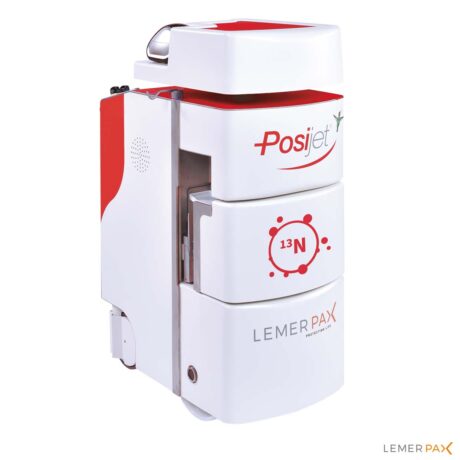
Building on its collaborative work with user departments worldwide, Lemer Pax has once again put its technical expertise at the service of innovation by developing, in 2019, a Posijet® program dedicated to the fractionation and administration of the ¹³N-Ammonia radiopharmaceutical.
Exchanges between the Geneva University Hospitals (HUG) and Lemer Pax’s development teams enabled routine use of ¹³N-Ammonia dose preparations with the Posijet® starting in 2019.
The hospital now performs approximately 1,600 examinations per year, while ensuring a considerable reduction in exposure for medical staff.
Thanks to its collaboration with University Hospital Zurich starting in 2020, the Posijet® Ammonia version evolved further along two lines: optimizing patient dose preparation accuracy, and automatic injection directly from the Posijet®, in line with the tight timing requirements imposed by this exam’s administration protocol.

Why ammonia-13 for cardiac PET imaging?
Unlike SPECT, which typically uses technetium-99m, cardiac perfusion studies in PET-CT can be performed using two main radiotracers: rubidium-82 or ammonia-13. ¹³N decays by positron emission, allowing detection by the PET camera’s crystals. Its mechanism of action relies on a fundamental physiological property: myocardial uptake of N-13 is directly proportional to coronary blood flow.
Thus, myocardial hypoperfusion manifests as localized hypofixation of the radiotracer, visible and quantifiable on PET images. This direct correlation between fixation and perfusion makes ammonia-13 a leading diagnostic tool for functional myocardial assessment.
A radiotracer requiring mandatory local production
The 10-minute half-life of ¹³N imposes a major logistical constraint: the radiotracer must be produced on-site, using a hospital cyclotron. Unlike rubidium-82, which can be supplied in generator form, ammonia-13 is synthesized directly within the facility.
This local production requirement becomes an economic and operational advantage for hospitals already equipped with a cyclotron: reduced marginal production cost, complete autonomy, and no dependence on an external supply chain.
The ¹³N injection protocol: two injections, ten minutes, zero margin for error
A two-stage protocol under the camera
The ¹³N myocardial perfusion exam follows a precise, sequential protocol carried out entirely under the camera:
- First injection at rest: 180 to 200 MBq of ¹³N administered to the patient
- First image acquisition immediately after injection
- 10-minute wait for residual signal decay
- Pharmacological stress of the myocardium (vasodilator or inotropic agent)
- Second injection under stress: 250 to 350 MBq during peak stress
- Second image acquisition
This two-phase protocol, with different injected activities and an extremely narrow time window between the two injections, forms the core of the operational challenge posed to any automated injection system.
Client requirements: precision, speed, consistency
Every second lost between preparation and injection represents an irreversible loss of activity. An inconsistent flow rate would disrupt myocardial uptake kinetics and compromise the diagnostic quality of the images.
Technical challenges specific to ¹³N
Rapid decay: a race against time
With a 10-minute half-life, ¹³N activity halves every ten minutes. This means that the activity of the mother solution, at the time of sampling, must be very high to compensate for the predictable decay between preparation and injection. This characteristic makes manual handling particularly irradiating for nuclear medicine radiographers – technologists.
Before the integration of the Posijet®, departments preparing ¹³N syringes manually from the mother solution exposed their staff to significant extremity irradiation levels. Its high-energy activity (N-13 = 492 keV) and the high volumetric activity of the mother solution made this step one of the most irradiating in PET practice.
Approximate activity and volume: the dosing problem
Unlike radiopharmaceuticals delivered with a certified activity at a precise point in time, ¹³N produced by cyclotron presents approximate activities and vial volumes at the time of withdrawal. This inherent variability complicates precise dosing of the dose to be administered and creates a real risk of overdosing or underdosing.
In a two-injection protocol with different target activities (rest vs. stress), this imprecision is particularly problematic. It requires the injection system to have adaptive sampling capability, able to adjust the withdrawn dose to the actual measured activity.
Two patients simultaneously: the pressure on throughput
In high-volume departments, ¹³N exams may involve two patients simultaneously. The injection system must then be able to manage interleaved preparation and injection cycles, without compromising precision or operator radiation protection.
Adapting the Posijet® to ammonia-13: technical responses
Speed and precision of withdrawal
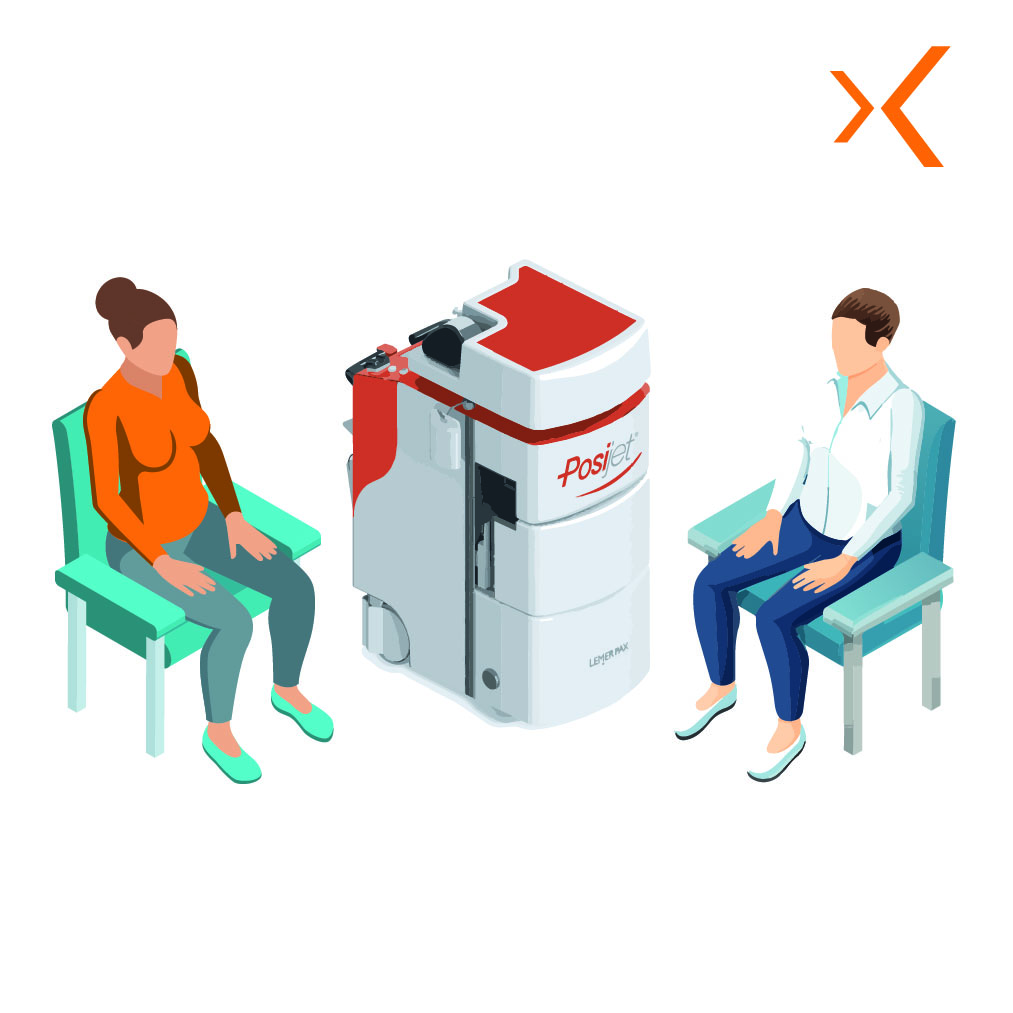
The specific development carried out by Lemer Pax for ammonia-13 focused primarily on optimizing dose preparation: rapid sampling, integrated activity measurement, and automatic adjustment to approach the prescribed dose despite the variability of the mother solution.
The machine is thus able to precisely sampling the prescribed dose, factoring in the calculated decay between the moment of withdrawal and the moment of actual injection.
Reduced purge and injection times
Purge and injection times have been optimized to meet the protocol’s requirements: 10-second injection, 10-second rinse. These performance levels are not simply a matter of fluidic sizing — they require precise management of flow rates, pressures, and rinse volumes, built into the Posijet®’s embedded software, which was entirely redesigned by Lemer Pax’s teams.
Results: what the ammonia-13 adaptation changed in practice
The integration of the Posijet® in departments performing ammonia-13 cardiac PET injections has produced measurable benefits across several areas:
Radiation protection: eliminating manual handling of high-activity syringes has significantly reduced extremity exposure for radiographers. This gain is particularly notable when preparing stress doses, the most irradiating step in the protocol.
Dosimetric precision: automated withdrawal, combined with integrated decay calculation, reduces inter-injection variability and improves the reproducibility of administered doses — a prerequisite for the diagnostic reliability of the exam.
Patient throughput: workflow optimization — sequenced and precisely timed preparation, injection, and rinsing — makes it possible to manage two patients simultaneously without compromising quality or safety.
Operator ergonomics: reducing the number of manual, risk-prone steps, combined with a clear interface, lightens the cognitive load on radiographers during exams.
The Posijet® as a response to the challenge of ultra-short-lived radiotracers
Ammonia-13 embodies a category of radiotracers for which injection automation is both a clinical and radioprotective necessity. Its 10-minute half-life, high activity levels, and two-injection protocol under the camera concentrate, within a single exam, nearly all the challenges a PET department can face.
The adaptation of the Posijet® to ammonia-13 cardiac PET injection, finalized since 2019, demonstrates Lemer Pax’s ability to develop tailored solutions for demanding clinical cases — well beyond standard isotopes. For departments equipped with a cyclotron seeking to develop or secure their ammonia-13 myocardial perfusion activity, the Posijet® today represents a validated and operational technical solution.

 France

